

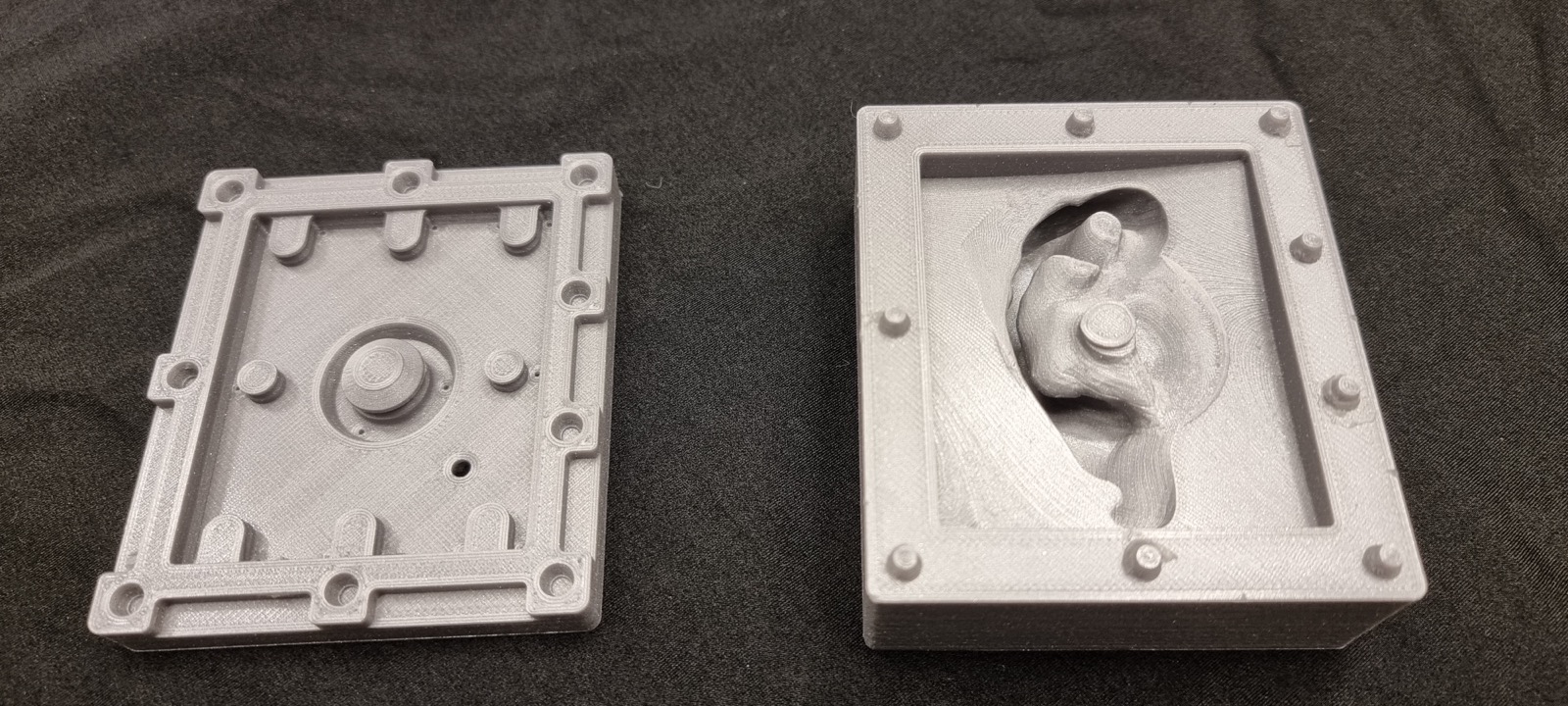
Publications
Research output
2026
A vibrotactile feedback prototype for transfemoral prosthetic sensory feedback, examining which interstimulus intervals (ISIs) and vibration waveforms best improve recognition of sequential tactile patterns on the forearm — informing a prototype to be tested with people with transfemoral amputation.
A decade-spanning review of vibrotactile sensory substitution research, arguing that successful devices require a thorough understanding of the underlying perceptual channels. Covers the capacity and limitations of vibrotactile stimulation for conveying information from a missing sense — particularly vision — to support mobility in visually impaired people.
A new structure-preserving model-order reduction for time-domain room acoustics based on the Linearized Euler Equations. The formulation eliminates instabilities present in conventional approaches and achieves a 3.5× speedup for full-order models, enabling faster yet stable acoustic simulations with complex boundary conditions.
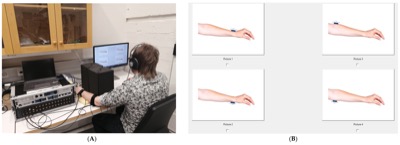
A forearm-worn vibrotactile system can convey prosthetic knee-joint position to transfemoral amputees without visual monitoring. Healthy participants reliably detected dual-actuator tactile cues encoding joint angles, validating the design parameters for a non-invasive proprioceptive feedback interface.
Amplitude differences drive vibrotactile discrimination — participants reliably distinguished wrist-delivered signals differing in amplitude, while frequency-only changes were near chance. Combined amplitude + frequency cues offered no additional benefit, indicating amplitude is the dominant perceptual channel for vibrotactile interfaces.
This study examined tactile working memory using sequential vibrotactile stimuli applied to the forearm. Capacity was approximately 4 items for ordered (spatiotemporal) recall and 5 items for unordered (spatial) recall, demonstrating that temporal order requirements impose additional cognitive load and reduce effective memory capacity. The findings define key limits of tactile working memory and underscore the need to limit information complexity in haptic system design.
2025
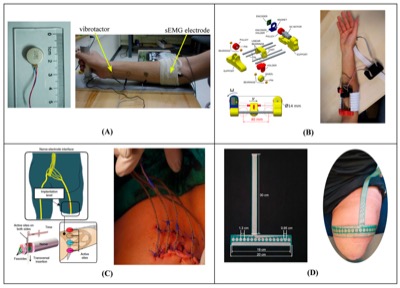
A comprehensive review of haptic feedback systems for lower-limb prostheses, covering system architectures, user experience, and clinical outcomes. Tactile feedback on limb position, gait events, and environmental contact significantly improves amputee mobility and device confidence — but standardized evaluation protocols are still needed.
Synthetic pinnae manufactured to precise specifications allow controlled HRTF experiments by isolating the effect of individual anthropometric properties — something impossible with natural ears. The approach opens a path to systematically studying how pinna geometry shapes spatial hearing cues.
Timing between vibrotactile pulses critically determines pattern recognition accuracy. Using a 6-actuator forearm array delivering Braille-based patterns, short patterns peaked at 92–98 % accuracy with 300 ms intervals, while longer patterns peaked at 86–94 % at 400 ms. Performance improved with training, highlighting the importance of optimized interstimulus intervals for vibrotactile displays.
2024
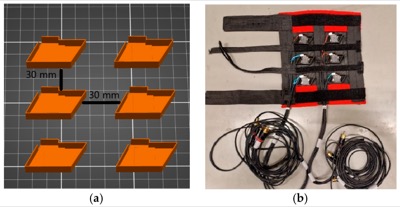
Sequential vibrotactile presentation vastly outperforms simultaneous delivery — pattern recognition jumped from 26 % (simultaneous) to 93 % (sequential) on a 2×3 forearm actuator array. Patterns activating 2–3 actuators were recognized most reliably, providing clear design guidance for vibrotactile communication systems.
Visual synchrony — targets changing color in unison — significantly shortened foraging times in multi-target search, grouping synchronized items perceptually. Contrary to the "pip-and-pop" effect, adding a synchronized auditory cue provided no additional benefit, even when task difficulty was substantially increased.
Auditory and vibrotactile cues synchronized to target rotation halved detection times during multi-target foraging in a 6×6 grid. A visual cue (frame polarity change) did not produce the same benefit — demonstrating that cross-modal, but not intra-modal, synchrony cues effectively guide attention when targets are defined by shared motion.
2023
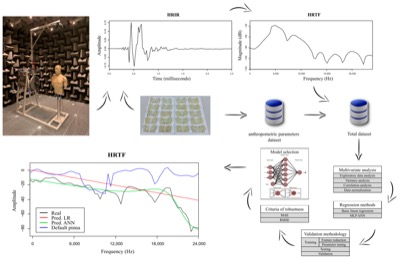
Machine learning models can predict personalized HRTFs from anthropometric measurements, moving beyond the conventional amplitude-vs-frequency analysis. The approach targets significant elevation cues in the spectral domain, offering a path toward individualized spatial audio without full HRTF measurement sessions.
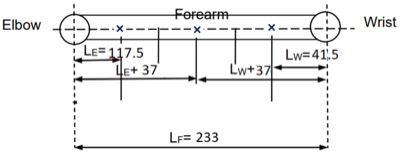
Frequency variation affects vibrotactile localization on the forearm — using a relative-point localization method with sequential stimuli at three forearm locations, participants showed that discrimination accuracy depends on both the frequency of stimulation and the spatial separation between actuators, informing optimal actuator placement for wearable haptic devices.
A methodological guide to building and evaluating haptic sensory-substitution devices that convey visual information through touch. Covers device design principles, psychophysical evaluation strategies, and practical considerations for translating laboratory prototypes into real-world assistive technology.
The intensity order illusion — where sequential vibrotactile stimuli of different intensities are systematically mislocalized on the lower back — is driven by amplitude changes alone, not frequency. This pins down the perceptual mechanism behind the illusion and informs the design of spatially accurate haptic displays.
This study evaluated vibrotactile spatial resolution on the forearm to determine optimal actuator spacing for sensory substitution. Using three Lofelt L5 voice-coil actuators embedded in a wearable sleeve, participants performed relative point localization tasks on both the upper and underside of the forearm. Results showed that an inter-actuator distance of 20 mm provided the highest discrimination accuracy, with no significant difference between forearm sides.
This study examined how stimulus frequency and forearm location affect vibrotactile spatial localization. Using an array of actuators, participants judged the relative position of sequential stimuli presented at 100, 200, and 250 Hz. Results showed that frequency had minimal impact on localization accuracy when amplitude was constant, whereas stimulus location on the forearm significantly affected performance. These findings indicate that actuator placement is more critical than frequency tuning for optimizing spatial resolution in tactile display design.
2022
A wearable sleeve with three voice-coil actuators delivers tactile accompaniment to music, creating an audio-tactile experience for cochlear implant users. Experiments showed the device enhances music perception beyond what the cochlear implant alone provides.
First systematic measurement of vibrotactile detection thresholds at the wrist (25–1000 Hz) using parallel-vibration actuators. Thresholds varied across frequencies and differed between the inner and outer wrist, providing essential reference data for designing wrist-worn haptic wearables.
A multi-layer perceptron trained on HRTFs from 48 individuals can replicate human sound-localization performance — determining the direction of an audio source from eardrum waveforms. Feature vectors derived from acoustical properties enable the model to match individual listeners' spatial hearing patterns.
Geometrical acoustics simulations can preserve the auditory cues essential for human echolocation, validated against the BRAS benchmark dataset. The work establishes requirements for virtual training environments that accurately reproduce echo-based spatial information used by blind echolocators.
2021
A simple computational model predicts the lowest-frequency pinna notch from 3D ear meshes with improved accuracy over prior methods. Higher-order notches remain harder to predict, but the model advances understanding of how pinna geometry generates the spectral cues essential for HRTF individualization.
2020
A public full-sphere HRTF dataset measured at 1 513 spatial positions on a KEMAR mannequin fitted with different custom-molded artificial pinnae. Provides a controlled resource for studying how pinna shape influences spatial hearing cues, enabling reproducible HRTF research.
2019
Discovery of a new haptic illusion: when two sequential vibrotactile stimuli of different intensities are applied to the lower back, participants systematically mislocalize the stronger stimulus in the direction of intensity increase. The illusion persists across motor types and spatial separations, revealing an intensity-order bias in tactile spatial processing.